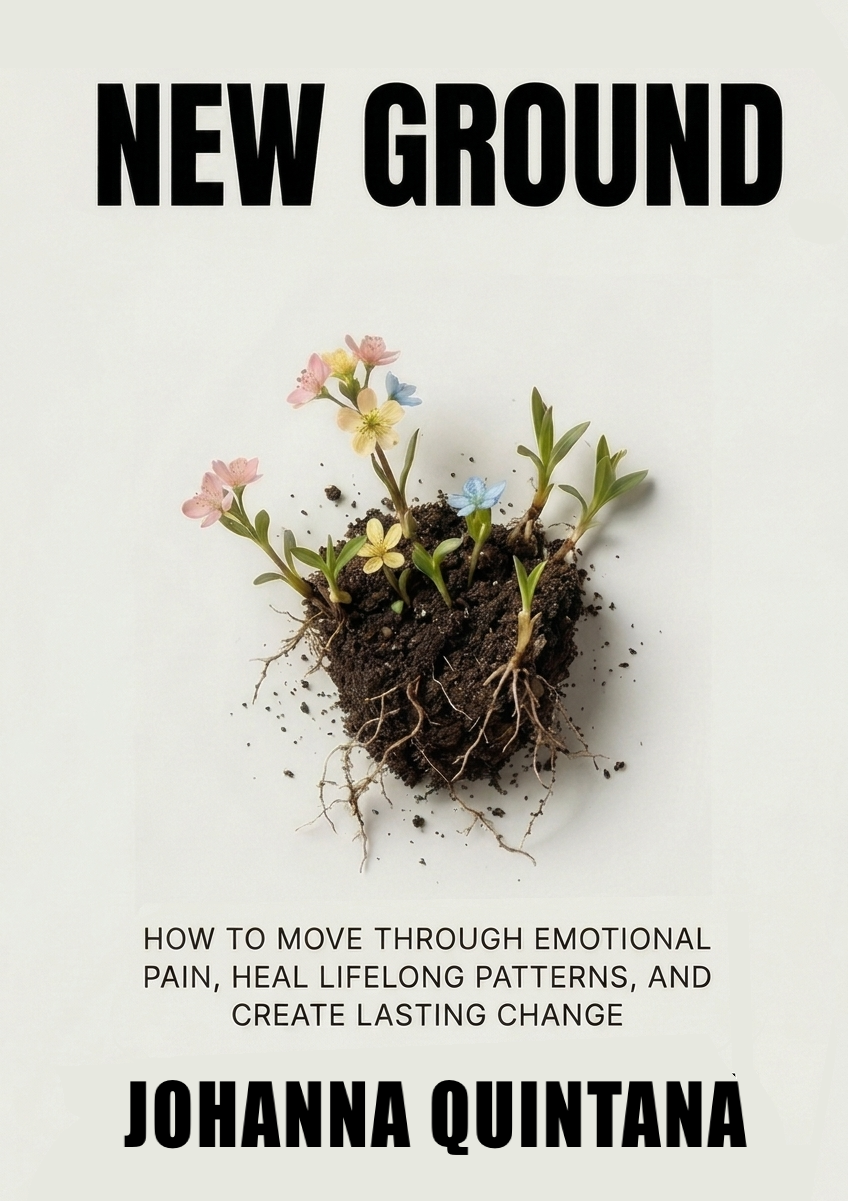
New Ground
For women starting over after DIVORCE OR loss

A guided pathway for women who already understand their pain to finally move through it and feel like themselves again

You can explain every pattern your heartbreak or loss has stirred up, and you still brace in the same places. New Ground gives you a step-by-step way to let the ache move through your body instead of explaining it one more time, so you feel steady and like yourself again.

Yes! Send me my copy for $20
Ebook only · Instant download

When you know exactly why it hurts, and it still hurts

"I know exactly why I do this. I just can't stop doing it."

Some version of that sentence comes from almost every woman who finds her way to this work. She can name the wound. She can trace it back to the marriage or to the parent who left. She has sat through the therapy, filled the journals and finished the books. She could probably teach the chapter on her own patterns.

Then her partner goes quiet over dinner, with short answers and eyes on the phone, and her chest tightens before a single thought arrives.

Have you had a day like that? From the outside everything looks fine. You're competent and you show up. Yet something in you stands half a step to the left of your own life, watching yourself do it well. Then at 2am, with no crisis at all, you're awake wondering why none of it lands.

Underneath, there is often a second sentence that never gets said out loud in a session: "Maybe this is just who I am."

If this sounds familiar, you're not alone, and you're not broken.

You haven't lacked effort or self-awareness. You likely have more of both than most people. What matters is where all that effort has been going. It has been going into thought, and the pattern was never stored there.
Why understanding your patterns hasn't stopped them repeating

The common belief goes like this. Understand the wound deeply enough and it will loosen its grip. Trace it to the source, find the right words, and the reaction will fade.

That belief makes sense, because insight helps. It eases shame. It gives you words for experiences that once felt confusing. For many women, an accurate account of what happened is the first relief they have ever had.

But insight has a limit, and New Ground gives that limit a name: the Insight Ceiling. It is the point where explaining stops producing change and starts protecting you from it. Past that point, every new insight becomes another ceiling. You know everything, nothing moves, and you decide the problem must be you.

The skill of understanding your pain can turn into a polished way of keeping it at a safe distance. You get close enough to study it and stay far enough away that you never have to feel it.

The story changes, but the sensation stays.

— Johanna Quintana

Why more talk therapy and more self-help stall in the same place

Take the dinner moment again. The breath shortens. Attention narrows. The urge to pull away, to please or to take control shows up before any full thought has formed. The body reacts first, and the explanation comes afterward.

That order is what makes so many good approaches stall. Talk therapy, journaling, mindfulness apps and books all work at the level of thought. Johanna still uses cognitive therapy. She calls it the map. A map can show you where the path gets steep, but it can't walk the path for you.

Working alone has a second limit. When you sit with a hard feeling by yourself, the part of you that decides when to stop is the same part that has spent years keeping that feeling at a distance. So you close the journal one breath too early, every time, and that is a very understandable response.

Why I wrote this book

It was three in the morning, after my husband decided to end our marriage, and I sat alone with a clinical vocabulary that had become useless.

I knew exactly what was happening to me. I could name the grief, the attachment wound and the way my identity had split open. I'm a licensed Clinical Social Worker, and I could explain every piece of it. None of those words reached the pressure in my chest.

I wasn't only losing a husband. I was losing my sense of home, the future I had counted on, and the version of me who lived inside that life. I had spent years helping people make sense of their pain, and now I barely recognised myself.

Things began to change when I stopped trying to understand the pain and started staying with it. I rested my attention on my chest and stopped reaching for another framework. I let the pain exist without asking it to teach me anything.

The pain didn't need a more accurate name. It needed my presence.

What followed felt like being born again. I had to make a new life from the old one. The question I lived with also changed. I stopped asking only "Why is this happening to me?" and started asking "Can I stay with what's happening inside me without leaving myself?"

That question became my work. New Ground is the book I wish someone had handed me at three in the morning.

Why feeling the ache in your body moves what years of explaining couldn't

When you stop explaining the pain and stay with the place in your body where it sits, it starts to move.

The reason is simple. Your reaction was learned by your body, often before you had language for it. What the body learns through experience, it relearns through experience. A better sentence doesn't reach it.

Milton was 27 and had done therapy before. He could describe feelings he had never once let himself have. The first time he stayed with the sensation in his chest instead of narrating it, he expected to lose control. He didn't. The feeling shifted, and he found he could stay with himself while it happened.

A feeling you let yourself feel does something that a feeling you keep explaining never does. It passes.

The Clarity Arc

The Clarity Arc uses cognitive work as the map and your body as the ground you walk, with breathwork and somatic attention at the centre. You keep everything you already understand. The Arc gives that understanding somewhere to land.

01
Name What You Carry
You see the pattern, the older wound underneath it, and the job your defences have been doing to protect you.
02
Feel It Through
With slow breath and attention, you let the ache move through your body instead of explaining it again.
03
Steady Yourself
Short daily practices settle you in a couple of minutes, so you respond to what's in front of you instead of reacting from the old wound.
04
Reparent and Rebuild
You give the younger part of you what she never received, you grieve what you never had, and you shape a new life from the old one.
Yes! Send me my copy for $20
Start with the first stage today · Instant download

What Others Are Saying

"This work has truly changed the way I hold and support myself. I feel calm and at peace with the life I've been able to build"

— Lena, Clarity Health

"If it wasn't for Johanna's guidance I wouldn't have been able to make it out of the darkest time I've ever experienced. She guided me with care, patience and confidence"

— Dana, Clarity Health

How Camile went from not recognising herself after divorce to feeling steady

Camile was 42 when she came to Johanna. Her marriage had ended, and what she described went deeper than grief. She no longer recognised herself. She could explain everything she carried from her past, and that fluency gave her no comfort. Her fear was that understanding would never change anything.

At one point they stopped explaining her pain and went to where it lived in her body. She stayed there, and something that hadn't moved in years began to shift.

"I started working with Johanna during one of the hardest periods of my life. I felt lost after my divorce and didn't recognize myself anymore. This work helped me understand what I was carrying from the past and how it was showing up in my relationships. I feel more steady now and clearer about who I am and what I want." (Camile, 42)

Notice the word she reaches for. Steady is a body word. You can't think your way into it.

More From Johanna's Clients

"I always thought I was just 'bad at relationships,' but through therapy I began to see the deeper patterns underneath that belief. The mix of talking things through and working with my nervous system made a big difference. I don't react the same way I used to, and I feel more secure in myself."

— Patrick, 34

"I had done therapy before, but this felt different. The process helped me access emotions I had avoided for years and actually move through them instead of just talking about them. It wasn't always easy, but I feel lighter and more connected to myself than I have in a long time."

— Milton, 27

"I very much appreciate it that we can have sessions in English and Spanish, and shift back and forth between cultural references and perspectives... she has proven to be a catalyst for personal growth that I never thought I could achieve."

— Michael C., San Diego
Yes! Send me my copy for $20
Ebook only · Instant download

What You'll Discover Inside

01
Why understanding your pain stopped making it smaller
Johanna calls this the Insight Ceiling, the point where explaining a feeling starts keeping it at arm's length, and you'll learn how to spot it in yourself.
02
How to tell a feeling apart from the story about it
"I feel rejected" is a conclusion, and "My face feels hot and I want to leave the room" is something you can actually stay with.
03
A one-sentence test for whether anything is shifting
It starts with "If this worked, the first thing I would notice is…", and the answer that counts names a place in your body.
04
How to recognise the reasons you keep giving yourself for waiting
Four short prompts help you find the "sensible" delays that are quietly protecting an old wound.
05
Why cognitive therapy is the map and your body is the ground underneath it
The plainest explanation you'll find of why you can know your whole pattern and still react before you can think.
06
A one-minute practice for the next time the ache shows up
Breathe slowly, find exactly where it sits, and stay one breath past the moment you'd usually leave.
07
How to catch yourself before you hit reply
The book calls the first tightening "the brace," and a two-minute settling practice gives you room to choose your answer.
08
How to name what your defences have been protecting you from
A single fill-in sentence turns self-criticism into something closer to respect.
09
How to give the younger you what she never received
A gentle present-tense exercise ends with one small, concrete act you can offer yourself today.
10
Why grief for what never happened matters as much as grief for what did
It explains why moving on too fast leaves part of you still waiting.

Is This Right For You?

This is NOT for those who:
  • Are in acute crisis right now. Please reach out for immediate support first. This work can wait for you.
  • Want one more clever reframe to file next to the others.
  • Would like confirmation that the whole problem is the ex.
  • Plan to read the exercises without doing them. They take a minute, and they're the part that works.
This is for:
  • The woman who has done serious work on herself and is tired of being the most articulate person in the room about a pain she still can't put down.
  • Women whose marriage ended, or whose life they were counting on came apart more quietly.
  • Anyone with something in her that is ready to stop studying the ache and start meeting it.
Yes! Send me my copy for $20
Ebook only · Instant download

Frequently Asked Questions

Is this just another book about understanding my patterns?
No. There are hundreds of those, and many are good. New Ground is written for the woman who already has that understanding and is still stuck. Johanna says it plainly: if you finish the book with a better explanation of your pain and no more ability to stay with it, she hasn't done her job.
I've already done years of therapy. Will this feel like starting over?
None of it gets thrown away. Your insight brought you here, and the book treats it that way. What it adds is the part that insight can't do on its own, which is the body's part.
Can I do this alone, or do I need a therapist?
Every exercise you need is on the page, and you can start today. The book is also honest that some of this work goes further with a guide beside you. If you'd like that, it ends with an invitation to a free conversation with Johanna, and you're free to take it or leave it.
How soon will I notice something?
The book won't promise you a timeline. The first signs are usually quiet. Your breath reaches a little lower, or there's a bit more space between what you feel and what you do next. You'll learn how to recognise those signs and trust them.
What if the exercises bring up too much?
You stay in charge of the pace. The practices are short on purpose, often a single minute. If you can't stay present, you stop, look around the room and feel the chair beneath you. Pushing past your limit doesn't make the work go deeper.
Does the book talk about ketamine?
Yes, briefly. It explains where Ketamine-Assisted Psychotherapy can fit for some people, always inside an ongoing therapeutic relationship and only after an honest clinical assessment. It is never assumed, and nothing in the book asks you to use it.
Johanna Quintana

Johanna Quintana.

Johanna Quintana is a licensed Clinical Social Worker, a certified breathwork practitioner, a certified somatic practitioner, and certified in Ketamine-Assisted Psychotherapy. She founded Clarity Health, where she works in both English and Spanish with adults who are high-functioning yet keep running into the same relational and emotional patterns.

Her training gave her the language for pain. Her divorce showed her its limits. When her husband ended their marriage, she went through the worst emotional pain of her life with every clinical term at hand and no way to hold herself through it. She had to make a new life out of the old one.

That passage changed how she works. She believes most people were never taught how to emotionally support themselves. More often they were told to stop being so emotional. Her mission is to teach women to stay with a feeling without silencing it or being swept away by it. That skill can be learned, and once your body knows it, you carry it into every relationship.

What your life can feel like when the old reaction stops deciding for you

Picture a morning when you wake up and the breath goes further down than it used to, past the collarbone, past the place where it always stopped. Later, someone you love goes quiet. You notice the tightening, breathe once, and ask a plain question: "You seem far away tonight. Is something going on?"

You hear the answer because you're still in the room.

The old reaction may still start. It just doesn't make the decision for you anymore. You know what you want, your choices feel like your own, and you recognise the woman living your life.

That is what New Ground is for. Get your copy today, and give the ache its first minute tomorrow.

Feel like yourself again

Stay steady when the old reaction starts
and feel like
yourself again

New Ground gives you a four-step way to move the ache through your body instead of explaining it one more time.

Yes! Send me my copy for $20
Ebook only · Instant download